Showing posts with label One-Off Book Reviews. Show all posts

Saturday, 25 June 2016

I Am The Messenger

By Markus Zusak


In this review, I look back at Markus Zusak's book, I Am The Messenger.

THE SHORT

Ed Kennedy is just your useless, everyday cab driver when one day, he accidentally stops a bank robbery. Then he starts receiving mysterious aces in the mail and he becomes the Messenger... While Zusak clearly had an original idea in a Messenger that helped (or hurted), it seems as though he didn't think it through, and we never get a satisfying conclusion or closure as to who is directing Ed's mission. Zusak races towards a rushed ending, and the ending is so ambiguous, one is left confused. And indeed confused is the word as Zusak uses way too much figurative language in his book, and one can't tell if the thing is really happening, or if it was just another linguistic trick by Zusak. Moreover, what Ed is supposed to do is also left unclear, as well as how he figures out what to do. In fact, the main pushing point of the story, the secret, all-knowing society, is completely glossed over! A major disappointment, both for the underdeveloped society, the ambiguous ending ("modern twist" my foot), and for the book in general. Clearly, Zusak has a lot of room for improvement.

THE REVIEW

Ed Kennedy is, perhaps, the least relatable of Zusak's characters. He is snobby, and doesn't even contribute anything to the story overall. Despite being the main character, one never truly connects to Ed in the human way that Zusak later created in Liesel in The Book Thief. Perhaps one reason this is so is because we never get to know Ed, never know his motivations, what caused him to give up university in the first place. Too much is left unknown about Ed, and this hurts the story overall.

Next up we have the backdrop of the three characters, Audrey, Marv and Ritchie. While they are indeed supporting characters, one expected them to be more developed to the underdeveloped nature of Ed. And here Zusak sorely lets us down once again with his blend of unclear and ambiguous figurativ language which doesn't explain a single thing about the three supporting characters. This results in a group of mostly unrelatable main characters. Also, the four of them never actually undergo any development from the start to the end, and we never see how Ed's messages affect the three of them. Indeed they undergo so little development that Zusak actually has to resort to Ed giving them messages to kickstart the developmental process.

In fact, this book is so unfulfilling that it doesn't even have a main antagonist. Most of the novel is spent residing in Ed's brain, but the confusing use of words and nouns all jumble up to form an incoherent narrative that can never achieve lucidity. Zusak tripped up here and none of his figurative comparisons survive to make a meaningful impression on you as he just vomits all of his metaphors and similes out to you.

One of the major themes in this disappointing book is the theme that ordinary people can do great things. Being consistent with the other things in this book, Zusak aimlessly and themelessly wanders around for like 90% of the novel, before rushing to a conclusion in the epilogue part. In fact, a large part of the novel, you have to ask yourself "Where the hell is this going? What kind of impact does Zusak want to impress on us?" And it turns out, he's going nowhere with his rushed theme which feels squeezed in just for show, and he doesn't want to impact you at all. Not in the slightest with his useless theme. Underdescribed, it just doesn't permeate throughout the whole novel and give you a resounding moral lesson at the end of it.

In terms of plot, there are so many holes that I don't even know where to start. First off, there's the whole issue of Ed knowing exactly what to do and how the cards know that he'll know what to do. In fact, Zusak doesn't even explain Ed considering just giving up and not caring about the cards. Zusak, meanwhile, makes things even worse by showing up at the end and saying that he killed Ed's father. HELLO? And Ed doesn't even respond when it was shown earlier that he loved his father! Meanwhile, how Ed knows what to do is just supposed to be accepted, no questions asked. Most people in his place would have put it down to a hoax or a scam. And what does the shady character at the end of the book (speculated Zusak) have to gain from all of this? Reassurance that ordinary people can do great things? And how does the shady character spy on Ed? This never gets explained, and tons of other questions that Zusak never answered because of his unsatisfactory ending that explains ABSOLUTELY NOTHING!! A secret society with murderous members would have served it way better and tied up so many loose ends than Zusak's "modern twist".

<<Positive things about plot not found>>

All in all, this book was a severe letdown. Zusak's irritating diarrhea of figurative language bogs down the book, and the ending is unsatisfactory and doesn't explain a single thing at all.

Rating: 2.1/10
Advice: Just skip it. Just skip this horrid mess of a book.

Reading this book was absolutely torture. I sincerely hope I never read another book as horrible as this.

Next week: I return to the Hunger Games franchise with my review of The Hunger Games: Catching Fire. While the 74th Hunger Games may be over, sparks of a rebellion are present in Panem, and Katniss Everdeen has not quite finished her run of Hunger Games yet... Did Suzanne Collins manage to deliver a successful sequel to her first book? Or was Catching Fire thoroughly boring and unentertaining? Find out next week in my review of The Hunger Games: Catching Fire!!!

Sunday, 19 June 2016

Coraline

By Neil Gaiman


I review Neil Gaiman's Coraline in this book review.


THE SHORT

A novel of purely escapist proportions, Coraline finds its titular character stuck in an alternate world where the other mother plots to steal her soul. While one enjoys the other reality that Gaiman creates, and the imaginative turn that his story takes, one feels that it is more of a novella than a real novel, a set up to a far greater book. However, this is not the case, and one has to be resigned to the limited range of characters that Gaiman brings to the table. Despite the greater freedom that Gaiman has to develop his characters, over time the nagging voice of Coraline seems to take over the whole book. The escape from the other mother is far too simple, and the draggy ending tacked on at the end feels from a whole other book. The plot is, however, solid, and leads convincingly from one end to another. The threatening menace of the other mother is wonderfully fleshed out, making her a very real and very dangerous villain. All in all, Coraline is a good novel, but one that ultimately lets you down, failing to meet the expectations that you had formed of it from the beginning.

THE REVIEW

In this novel, the reader is made perfectly clear of Coraline's disposition and character, as one of a bored girl struggling against her parents who couldn't be bothered less. It's a well known trope in literature, like in Matilda. Anyway, Gaiman goes out of his way to set up her character, spending almost the first two chapters devoted to fleshing out the character of Coraline. However, it goes to the point that you feel sick of Coraline, and this doesn't stop as Gaiman continues to spend the whole book inside Coraline's head. Indeed, Gaiman succeeds all too well, as his girl protagonist, while being relatable, becomes annoying and naggy, complaining about everything. Instead of not developing his characters enough, Gaiman develops them too much, and his characters suffer as a result of this. However, Coraline does show some signs of development towards the end of the book, learning the value of bravery and realizing that ordinary life does have its own benefits.

The other mother, her antagonist, is a marvellous villain, unprecedented. Gaiman truly had an original idea when he thought of the demonic thing that posed as Coraline's other mother. The sad part is that we never get to know what the other mother truly is, whether she's a god-like thing, or a being from another dimension. One wishes that we could have known more about her, or that Gaiman had fleshed out her character more.

One of the major themes in Coraline is that of bravery. While it may unnoticeable to some, like it was to me the first time I read the book, the second time around there was distinct air of the theme of bravery. Gaiman even writes in a story about bravery into the book. Covered up by the writing, the theme doesn't really succeed that well, kind of like Alice's Adventures in Wonderland, the book Coraline is normally compared to. The nice thing is that the theme is layered under just enough writing to make it obvious, but also enough that it's not too obvious.

The plot of Coraline, is, as I have stated above, solid. It leads strongly from the beginning to the end, except for the hand thing I'll talk more about later. As it is, Gaiman builds a convincing plot, making us believe that it really could have happened like that. From the beginning, the part where Coraline explores around the house, to the middle, where Coraline is trapped in the other world, to the end, where Coraline traps the hand down the well, it all happens with a strong lead to the other.

The major flaw of the plot is mainly the ending part, where Coraline throws the hand down the well and keeps it there forever. This part seems tacked on, almost as if it came from another book. One feels that the closing of the door on the other world had to be the end, that even the closing the door was symbolic of the end of the book. However, Gaiman had to stretch the book on for a few more chapters, almost as if he knew the book was far too short. As such, the ending fails to live up to the generally rich storytelling that permeated the rest of the book, and you are left with a bad taste in your mouth.

All in all, Coraline is a genuinely great attempt at the escapist wonder that Lewis Carroll crafted in Alice's Adventures in Wonderland and Alice Through The Looking-Glass, but ultimately it feels unfinished, often blemished at parts. Gaiman certainly could have improved on it further, but unfortunately, he didn't.

Rating: 8.3/10
Advice: Perhaps it would be best if you revisited the Alice Adventures before reading this book. God knows that it can't hold a candle to those.

Maybe it's just me, or I just didn't feel that Coraline was Gaiman's best attempt at a story. Too much was left unexplained and it just didn't have that same ring of magic that the Alice Adventures did.

Next week: I tackle another Markus Zusak book in my book review of I Am The Messenger. When Ed Kennedy inadvertently stops a bank robbery, he starts receiving mysterious aces in the mail. And that's when he becomes the Messenger...Did Zusak manage to capture the magic from his literary phenomenon The Book Thief? Or did he bog down his book with too many things going on at the same time? Find out next week in my book review of I Am The Messenger!!!

Saturday, 11 June 2016

The War of the Worlds

By H. G. Wells

H.G. Wells mania continues in my book review of The War of the Worlds!!!


THE SHORT 

When Martians invade Earth, an unnamed journalist is trapped in the clutches of these terrifying, death-dealing machines! As a science-fiction novel on its own, Wells succeeds in this novel, delivering a fantastic concoction of adventure, fantasy, all grounded in reality. The fast-pacedness of the novel is also a delight, as Wells picks things up and wonderfully maintains the momentum of the novel. However, the ending is a bit of a letdown, while successfully concluding the novel and tying up Wells's theme, it arrives much too sudden and there is actually no build-up to it. The journalist in this scenario seems extremely lucky, perhaps too much so, and one can sense the hand of Wells stirring up the novel so as to prevent the narrator's death. This novel is also without many supporting characters and while Wells creates another subplot, that is short-lived. Excepting the Curate and the artilleryman, there is no one else to listen to but the narrator. However the consistent journalistic style of the novel is to be applauded. Wells has created a most marvelous and delightful read in The War of the Worlds.

THE REVIEW

Instead of focusing on characterization like I normally do with other stories, here I will instead study the style and pacing of the novel. In this novel, none of the principal characters, bar Ogilvy, are actually named, as characterization in this novel is unimportant. This may be put down to the fact that this whole novel is written like a newspaper report, one to be published in, say, the Times. 

The style of the novel, as I have said, is that of a journalistic one. In fact, Wells remains in character for the entirety of the novel. The facts are stated in a clear-cut way, no beating around the bush and no dramatization common in sci-fi novels. It is to be admired that Wells is consistent throughout the whole novel, and never once deviates from the chosen style.

The pacing, however, often leaves something to be desired. Starting off slowly with the landing of cylindrical Martian container, Wells speeds things up with the escape of the narrator, while also throwing in another story about his brother. However, the fast-paced story about escaping from the Martians gradually slows down when the first part ends, eventually slowing down so much as to include the two slow weeks spent with the Curate. A last spike with the capture of the Curate, and then the plot slows down all the way to the narrator's sudden realization that the Martians are dead. One indeed feels that Wells could have displayed the same consistency as he had with the style of the novel.

The primary antagonists here are, of course, the Martians. Wells succeeds in painting them as uncaring villains, however one feels a bit of dissonance, perhaps introduced by Wells's sympathetic comparison of them to us wiping out the dodos. One downfall of the studious style of this novel is the fact that we never get to truly know any of the characters, and thus are unable to relate to them, understand them, and let them leave an indelible impression on us.

The main theme in this novel is, perhaps, the way humans have no control on what happens on Earth. This is mainly explored through the fact that it is the bacteria that finally kill the Martians, not the humans themselves. In the end, it is not the complicated machines man invented that bring them down, it is the simplest of all things, the things that have survived from the very first life on Earth, the bacteria, that defeats the Martians. The utter simplicity of this rings true to the theme, and brings it out wonderfully.

Wells also explored the butchery of the animals, and reversed it. When the humans are suddenly the ones being killed and used as food, suddenly it becomes awfully clear what the animals feel when humans kill them. Perhaps this is even more applicable in the modern day, when more and more animals are being killed, that we have to be reminded of the pain that the animals experience. This theme injects a sort of meaning into this novel. It is even more unusual in Wells's journalistic style, as themes are usually not explored in journalistic writings, but Wells fits in smoothly with the story.

The plot in this novel is, perhaps, the archetypal plot for all other invasion literature novels. Extraterrestrial beings invade Earth -> Deal out death -> Just when it seems impossible for the humans to win, some sort of intervention or new technology defeats the beings, ensuring the victory and survival of the humans. Wells perfectly captures the awe and amazement of the humans at the discovery of new life, and also manages to craft a compelling plot, one full of suspense, adventure, and horror all smoothly mixed together to create an amazing cocktail of a novel. Indeed, Wells also managed to squeeze in his themes of butchery and humanity's complete loss of control.

However, there are some problems with the plot, the biggest one of them being the narrator's lucky escapes, time and time again, avoiding the Heat Ray, the poisonous Black Smoke. One can almost sense the Hand of Wells ensuring that the narrator survives, spoiling the realistic background in which this novel is grounded. Also, scientific problems such as how the Martians were able to survive the much hotter temperatures of the Earth, and how they were able to regulate their internal body pressure when the Earth's external air pressure is so much different, and how they were able to adapt to the atmosphere AND how they managed to go through the Earth's protective layer of atmosphere WITHOUT burning to pieces are completely glossed over. However, this may be for the better, as the novel would have been too bogged down with details had Wells included the explanations for these in his novel.

All in all, The War of the Worlds is a most entertaining read, a classic science-fiction novel, well and truly deserving of its reputation which had held up over all these years. The plot and style of this novel are solid, and one cannot ask for a better science-fiction story.

Rating: 9.4/10
Advice: Read the whole thing. The WHOLE thing. Nothing of this masterpiece is to be skipped.

I truly, truly enjoyed this novel. Such an amazing thing, contained within just the pages of a book.

Next up: Some critics have called it the Alice's Adventures in Wonderland of the modern day. Whatever it is, watch as I review Coraline, the best selling book which was turned into a movie! When Coraline Jones finds a door leading to another world, she quickly realises that not all is as it seems, as an evil other mother tries to imprison her in the other world by sewing buttons onto her eyes! Can Coraline escape? Find out in my review if Coraline is an innovative and fun book to read, that spirits you away to new worlds, or if it is merely a failed stand-alone book! Coming up next week!

Saturday, 4 June 2016

The Time Machine

By H. G. Wells

In this book review, I travel back in time to review the science fiction classic, The Time Machine, written by H. G. Wells.


THE SHORT

In this novel, often considered the forerunner of all the time-travelling so favoured by modern sci-fi authors, H. G. Wells serves up an entertaining classic. A Victorian scientist is propelled into the future, where humanity has divided into two species, and one of them wants to stop his return to Victorian London. While it certainly is an original thought at the time, Wells seems to have run out of ideas for his futuristic species, and about half of the novel is spent dwelling on the Eloi, and this bogs down the story. Also there seems to be absolutely no plot at all when the Time Traveller first arrives in the future, Wells having to resort to philosophical ramblings about the future. This is evident when he encounters the Morlocks, and the philosophical thoughts nearly double. As it is, this novel is short on plot, and it wanders aimlessly for quite a bit. Overall, this novel, or should I say novella, is just a good one. It is certainly original, yet plot is sacrificed for thoughts on human future.

THE REVIEW

The main character of this book is the Time Traveller, a person whom we never actually learn the name of, and whom we only see through the eyes of a student. As such, we never relate to him on a personal basis, and this kind of ruins the feelings that Wells was trying to create for us when Weena dies. Wells also never develops the character, and the Time Traveller actually doesn't express any emotion in the entirety of this novel, making it impossible for us to enjoy the emotional stakes that Wells creates throughout the book. So this character remains a figure on the page, two-dimensional and foreign.

The narrator of this novel is an unknown student who regularly visits the Time Traveller in his home, and since most of the book is told in the perspective of the Time Traveller, I won't dwell too long on him. The narrator here, too suffer from the same problems that the Time Traveller suffered from: Underdevelopment.

The main antagonist here are the Morlocks, faceless collective villains who act like futuristic zombies. Really. There are no cleverly thought out plans, no elaborate schemes to kill the protagonist, excepting the theft of the Time Machine. Most of the times, they are blundering about blindly, exactly like zombies. It seemed like Wells ran out of ideas and had to use these as antagonists. Perhaps he was merely trying to state that in the future there were no individual villains. Either way, the Morlocks fail as frightening villains.

The themes here are how everything will degrade eventually and how the present will affect the future in unexpected ways. The first theme is explored through the Morlocks and the Eloi, and how none of them actually resemble humans. The Morlocks are ape-like cannibals, and the Eloi are comforted babies, unaware of the danger below. While the Time Traveller had expected civilisation to advance, he found out that it had actually degraded, the future displaying none of the technology that he had expected it to have. The only glimpse that the Time Traveller gets of the "glorious future" is in the castle of green porcelain.

The second theme is explored through the difference between the Morlocks and the Eloi, and the Time Traveller's realisation that their difference is due to the current state in Victorian London. This realisation leads to the conclusion that the future is affected by whatever is happening in the present.

In this book, the plot is, as I have said above, strangely lacking in a science-fiction novel, one of the genres notorious for its plot-laden books. In fact, if Wells hadn't included the philosophical thoughts, this novel would be even shorter than it is now. As it is, this novel is so lacking in plot that one feels that one is reading some kind of philosophy textbook, which really lets the reader down, and actually confuses him. While one expects some kind of moral in science-fiction stories, Wells really piles it on in this novel.

On the flip side, Wells manages to craft a suspenseful part in the book, which comes in the fiery forest finale, in which Weena dies and many of the Morlocks are killed. Here, the talents Wells displays in The War of the Worlds in writing about destruction actually improves the story, and provides a much-needed action boost to what was then a dreary theory about the future, concocted by Wells but which we don't actually care. Wells also squeezes in some kind of mystery in the plot, sustaining the momentum of the book when he is done describing the trip to the future and just kind of wanders around aimlessly until he hits upon the idea of the disappearance of the Time Machine.

The pace of the novel is also irregular, starting slow at first, but then rushing to climax in the forest, and then slowly subsiding. The science of this book is also underexplained, leaving some confusion and disappointment in readers.

Overall, The Time Machine is a delightful little novella which will entertain you, but actually don't think too much about the philosophical consequences which accompany this novel. Wells failed in trying to fit this in smoothly with his story, and as a result both his story and his moral, which he wanted you to find, suffer.

Rating: 7.3/10
Advice: Perhaps it would be best if you ignored what the morals are in this story, and enjoyed the time-travelling nonsense which actually serves as brilliant escapism.

I feel this wasn't Wells's best book, but maybe he had been distracted by other commitments.

Next week: H. G. WELLS MANIA CONTINUES!!! In my review of H. G. Wells's novel The War of the Worlds, watch as Martians invade Earth and seek to colonise the entire planet, with the aid of seemingly indestructible machines! Make sure to come back next week and check out my review of The War of the Worlds!!!

Saturday, 16 January 2016

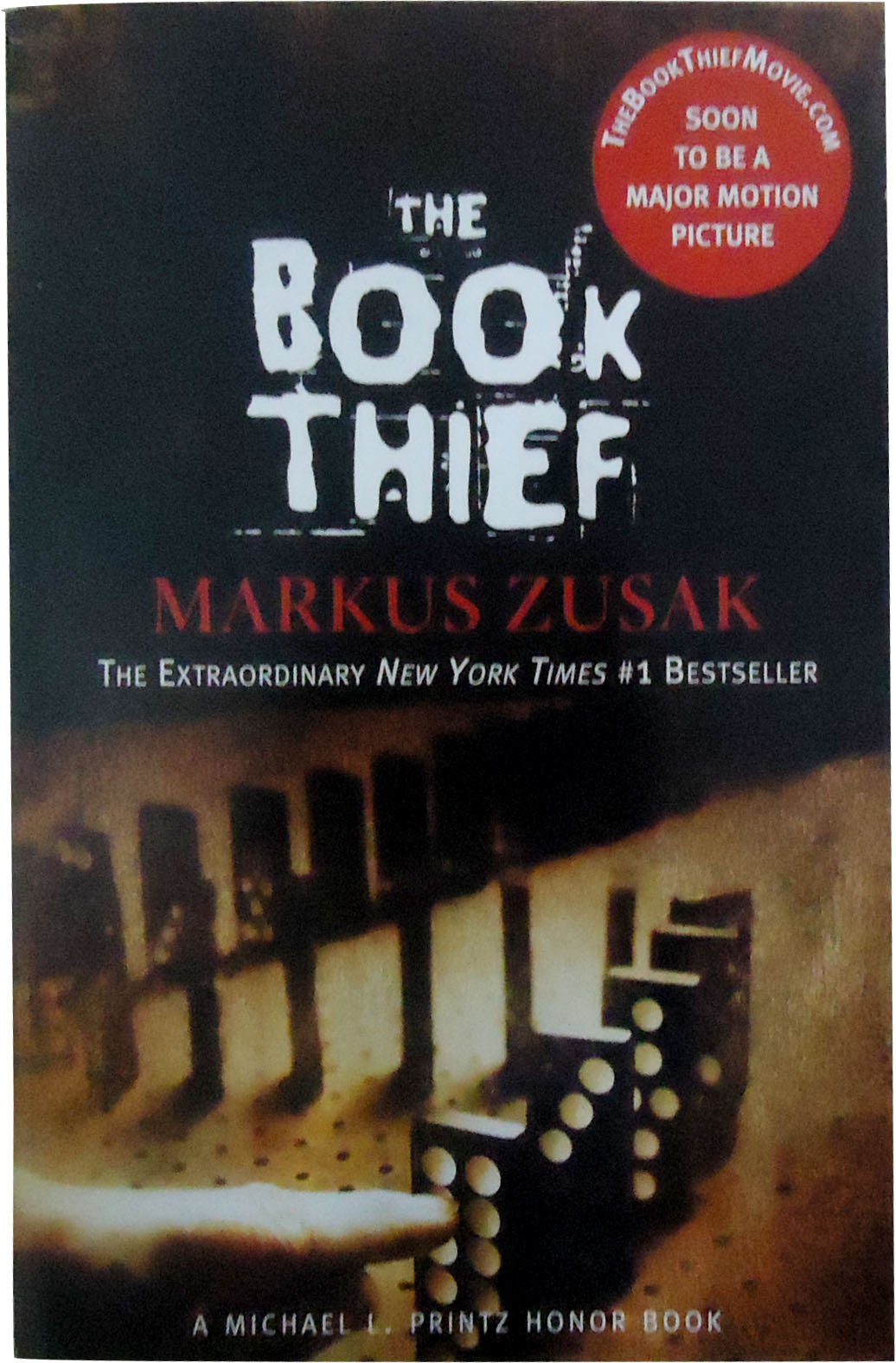
The Book Thief

By Markus Zusak


In a heartwarming book set in a not-so heartwarming Nazi Germany, World War II rages around a girl as she learns to read with her foster father, and then embarking on a career of book-stealing.

Liesel Meminger is travelling in a train with her brother and mother, but then suddenly, due to a coughing fit, her brother dies. The train stops due to faulty track work and then, two train guards decide that the three of them should be sent to the nearest township. There, her brother is buried. It is only when her mother drags her away that she notices a small black book on the ground and takes it.

Then it is revealed that the mother is sending Liesel away to foster parents. Liesel nearly breaks down when it is time to say goodbye, but say goodbye she does, and she meets her new parents, Hans and Rosa Hubermann. One tall man and one squat lady. Later in the night, Liesel sleeps, and the narrator, Death, tells us the name of the black book: The Grave Digger's Handbook.

Slowly, Liesel begins to feel closer to Hans. He visits Liesel in the night when she has her nightmares, and comforts her. Hans paints and plays in bars for a living, while Rosa washes clothes. In a football match on the street, she meets her future best friend, Rudy Steiner. After a bed-wetting incident, Hans finds the book which Liesel had hidden under the bed. To help her read, Hans decides to teach her the alphabet. Soon later, they finish The Grave Digger's Handbook, and Liesel receives two books for Christmas: Faust the Dog and The Lighthouse. The war starts and Rosa starts losing her customers.

On Hitler's birthday, a bonfire is lit in celebration. In the remains of the fire, Liesel finds a few unburnt things, and steals one of the three books: The Shoulder Shrug. Liesel thinks that she has been seen by the mayor's wife, who is one of Rosa's customers. Luckily, the mayor's wife doesn't say anything when she delivers the washing. Then, one day, the mayor's wife brings Liesel to her library. Then the story switches to a basement where a Jew is hiding, a Jew named Max, who is revealed to have some connection to Hans. Liesel continues through her summer, reading The Shoulder Shrug every night, reading in the mayor's library, where Liesel finds out that the mayor had a son, who died in World War I. She plays soccer with Rudy, and finds a secret food-stealing group and joins them.

Max Vandenburg travels to see Hans, with a map, key and ticket hidden in a copy of Mein Kampf. Liesel and Rudy continue their stealing adventures, but then their leader, Arthur Berg, moves to Cologne. Max reaches Hans's house, and Death tells the story of Hans in World War II, where his life is saved by a Jew named Erik Vandenburg, who later died. Hans went to visit his wife and his son, and offered his help. Max's friend, Walter Kugler, visited him and they made a plan.

Max's history is told, and we learn that he enjoyed a good fistfight, which was where he met his friend, Walter. Then came Kristallnacht, the night of the broken glass. Walter came to bring him away, leaving Max's family behind, where he hid until he left to see Hans. Hans warns Liesel that if she tells anyone, everyone she knows will be taken away for questioning. Max sleeps in the basement, where he is covered up with some cleverly placed drop sheets and paint cans. 

Due to it being winter, the basement is freezing, and as such, Max sleeps with Hans and Rosa in the living room with a fire. Liesel asks if Mein Kampf is any good, and thus begins a storytelling phase between Liesel and Max, and slowly a friendship develops. It rolls around to Liesel's birthday, and in addition to The Mud Men, Max decides to give her something. He produces a small booklet called The Standover Man. Through the summer, the tension of hiding Max seems to ease a little. Then the mayor fires Rosa, and Liesel is infuriated and calls out the mayor's wife of hiding from the world. Liesel and Rudy join their stealing group again, except their new leader is a boy named Viktor Chemmel, a rude boy who only steals for fun. He gives Rudy and Liesel only one lousy apple, which causes Rudy to insult Chemmel, who attacks him. 

Liesel and Rudy go to the mayor's house and Liesel steals a book which she had been reading there: The Whistler. After a few weeks, they bump into Chemmel's group and he throws the book into the river. Fortunately, Rudy fetches it. Just a few days before Christmas, Liesel brings down some snow from outside into the basement, where they play. Then, disaster strikes and Max becomes seriously ill. He is moved to Liesel's bedroom, where he sleeps. Liesel reads to Max in an attempt to wake him up, but to no avail. 

She steals one more book from the mayor's library, The Dream Carrier. Then Max wakes up. The NSDAP start checking basements to see if they were the adequate depth for bomb shelters. She warns Hans and they decide to do nothing, trying to evade the notice of the Nazis. Fortunately, Max goes unnoticed.

One more book (A Song in the Dark) for Liesel from the library, but then Rudy notices a black dictionary against the window of the mayor's library. Liesel steals The Complete Duden Dictionary and Thesaurus, but then they discover a note for Liesel in the dictionary, one that entails how the mayor's wife let Liesel steal the books. During a raid, Liesel starts to read aloud from her books, and this transforms the shelter into a reading session.

A period of peace lasts, and an offer from Frau Holtzapfel, the Hubermanns' long time antagonist, comes. Liesel reading in exchange from her coffee ration. Thousands of Jews are paraded right before Liesel's eyes, and in stupid move Hans goes to offer bread to one of them. This results in both of them being whipped, and he realizes that the Nazis will come for him, and they will find Max. Max has to go, but Hans does not find him at the appointed place four days later. He waits for his punishment, but none comes.

Two men in coats come for Rudy, but Alex and Barbara, his parents, refuse. Hans's application to the NSDAP is approved and he is drafted into the war. Alex Steiner, too, is sent to the war. Rudy is furious and goes off on a rage to kill Hitler, accompanied by Liesel, but they soon return. For a Christmas present, Liesel is given Max's sketchbook: The Word Shaker, a collection of Max's thoughts and a story about a girl who collected words that grew from trees.

The mayor's wife gives Liesel some cookies, and she steals her last book: The Last Human Stranger. After an accident with a truck, Hans's leg is broken and he returns home. After an air raid, they notice a crashed plane, where Rudy places the teddy bear and the pilot dies.

During yet another parade of Jews, Liesel finds Max. She rushes over to him, and then first Max is whipped, then Liesel. She falls to her knees, while Max is marched away. She chases him, then is brought down by Rudy. After a book-tearing incident in the mayor's library, the mayor's wife gives her a small book to write her own autobiography inside.

Then the bombs rain down on the street where they all live, and everyone dies. Rudy, Hans, Rosa. All of them, except for Liesel, who awakes from the basement where she had been writing in her book. A horrible discovery awaits her, and slowly, as she discovers everyone she has loved is now dead, she disintegrates.

The mayor brings her to his house, where she meets Alex Steiner after the war, and then she finds Max, still alive, still breathing. Finally, Death takes Liesel and shows her, her book, which he had found.

This book is really a magnificent masterpiece, one that brilliantly entails how the Nazis changed life in Germany and a touching story about a girl and a Jew, an unlikely pairing.

Every page of this novel has at least one beautifully crafted metaphor that personifies and brings to life the non-living things in the book, and the emotions of the people around them are excellently shown. The novel's vivid descriptions let you really escape to Himmel Street, where they live. I get the feeling that this novel is born from the emotions of the humans, the relationships of everyone erupting around this common feeling: Love. Not love as in the flirty kind, but real love, the kind reserved for parents.

The topic of Hitler is touched upon in this book, and is most visible in Max Vandenburg, who has first-hand experienced the cruelty of Hitler and his Nazis. His flight from his family is perhaps the most regretful experience of his life, the cause of which, we all know, is the Nazis. We really can understand his feelings that are so incredibly described by Zusak, who plays like a virtuoso on a fleeing Jew's nightmares. In our mind's eyes, Max bursts to life.

The interesting proposition of Death as a narrator is a brain stroke by Zusak, who not only manages to bring the 'Grim Reaper' to life, but also as someone with whom we can empathize with. He humanizes Death, so that instead of getting a creepy picture of a Death who says supercilious things and is malicious and hateful, we get a Death who is bored of his eternal existence, and who is haunted with the thought of the survivors. Zusak describes death to normal people as Death carrying their souls away in his soft arms, to wherever they go next. Zusak even tears apart the old saying, 'War is death's best friend', and explores the possibility of God.

Liesel is yet another interesting character in Zusak's menagerie, the protagonist. At the beginning, she loses her brother, and so we can immediately see that she is the one who will struggle through loss, the one that will continue fighting no matter how hard the going gets. She is the tough one. But then, there are her nightmares, which are horribly fleshed out. The relationship with Rudy slowly develops from a platonic friendship, to something else, something above that. But then Rudy dies and she is left to kiss his dead lips. That moment truly is a tragedy, a culmination of Zusak's masterful writing and your emotions. The mental image is just so strong that you can't help but see it.

Zusak describes the sky as masterfully as he can, showing all the colors through the eyes of Death, who needs some distractions and turns to the sky for help. The strong and vivid colors are shown through the black and white of the letters.

On the flip side, however, the metaphors can be a drag for those who are looking for quick reading. Perhaps this is some device of Zusak's, to slow down your reading so that you can digest it better, but for myself it was a bit irritating to go that slow and take three minutes just to digest two or three pages.

Strangely enough, Zusak chooses to spoil the ending, and that kind of puts a damper on the emotions he wants you to feel.

All in all, while this may not be perfect, it certainly breaches the gate of greatness.

Rating: 8.7/10
Advice: Highly recommended reading.

The Reviewer hopes that you can enjoy this post and comment!

Next post: The return of James Bond in 'Live and Let Die'!

Saturday, 9 January 2016

Looking for Alaska

By John Green

A novel that became a bestseller nearly seven years after its release features a introvert boy named Miles Halter, who falls in love with beautiful Alaska Young. Then she dies.

In part one of the story, tentatively titled 'before', Miles's very bad social standing in his school is revealed in his 'going-away' party, to which only two acquaintances show up, and even then it is awkward. Miles tells his parents that the reason he decided to leave for Culver Creek Boarding School, his father's alma mater, is because of a particular poet's last words (which he came across due to his weird habit for memorizing last words) 'I go to see a Great Perhaps'.

When he finally arrives, he meets his roommate, Chip Martin, a short and muscular boy who dubs himself 'the Colonel' and decides to call Miles, 'Pudge'. Pudge then meets Alaska Young, an extremely stunning girl, friend of the Colonel. The Colonel reveals that Alaska is moody and loves books. On a swing near the lake in the school, she tells Pudge of Simón Bolívar's last words: 'Damn it! How will I ever get out of this labyrinth!' The two make a deal: If Pudge can find out what the labyrinth is, Alaska will find him a girlfriend. The Colonel also introduces Pudge to his other friend, Takumi Hikohito, a rapper.

On his first night at Culver Creek, Pudge is duct-taped by some Weekday Warriors (the rich and cool kids in the school), and thrown into the lake, which is supposed to be some school tradition, but without the duct tape. They blame it on the Colonel, whom they assume is responsible for ratting out Paul and Marya, who were caught by Mr. Starnes, the dean of the students, nicknamed 'the Eagle' and expelled for committing all three of Culver Creek's expellable offenses.

Later, however, Alaska admits that she was the one who ratted on Paul and Marya (Marya was her roommate) because she was about to be expelled and instead chose to rat to save her own skin. She introduces Pudge to a Romanian classmate of hers, Lara. Pudge and Lara go on a disastrous three-and-a-half date (Alaska going with her boyfriend, Jake, the Colonel with his out-of-love-girlfriend, Sara, and Takumi), in which Pudge gets a mild concussion and pukes over Lara's pants. Pudge starts to fall in love with Alaska.

Alaska and the Colonel plan a series of pranks to get revenge on the Weekday Warriors. First, Pudge and Takumi set off firecrackers near the Eagle's house to lure him away. Then, Alaska and the Colonel send fake progress reports to the Weekday Warriors' parents, saying that they have been failing their classes. Lara then puts blue hair dye in the Warriors' gel and shampoo. When Alaska is drunk, she tells Pudge about her mother dying from an aneurysm when she was young, and Alaska blames herself for her mother's death as she didn't call 911. Eventually, Pudge realises that the labyrinth is a person's suffering.

When they return, Alaska and the Colonel drink. Pudge and Alaska kiss, but Alaska says she is tired and asks to leave it 'to be continued'. Then suddenly, after a phone call, Alaska goes hysterical, and says she needs to leave the school. Pudge and the Colonel distract the Eagle by firecrackers while Alaska escapes.

In the second part, 'after', perhaps not as long as 'before', Pudge and the Colonel wake up to the Eagle telling them Alaska is dead. The Colonel is devastated, but Pudge believes it is only a joke. Only after the Eagle telling him Alaska really is dead then Pudge realises that she is gone, and will never be back. The Eagle says that Alaska died of a car accident, and the Colonel and Pudge blame themselves for her death, but change track when they find out that it may have been a suicide attempt. The Colonel is sour and says she was selfish if she asked them to help her commit suicide.

He decides to find out who called Alaska, and wants to question Jake, her boyfriend. Pudge is afraid that Jake will tell him that Alaska never loved him, and so refuses to go. The Colonel argues with Pudge and retaliates saying that Pudge only loved his own idealized version of Alaska, not the true version.

As a final prank to celebrate her life, Pudge, Takumi, Lara, and the Colonel plan a prank involving hiring a male stripper for their Speaker's Day. It is a success and they escape trouble. Pudge finds Alaska's copy of 'The General in his Labyrinth' with Bolívar's last words underlined and a note in the margin: 'straight and fast'.

Takumi suddenly remembers that the day Alaska died was the day after the anniversary of her mother's death. With this, they realize that Alaska must have felt guilty about failing her mother again, and so takes her own life. Takumi then leaves for Japan, telling Pudge in a note how he, too, had loved Alaska and let her escape on the day of her death. Pudge then forgives Alaska for dying and, then, finally, lets her go.

A beautifully written story, the lightness of the first part is stark next to the darkness of  the second. Pranks and death collide in this stirring novel.

Pudge is a bit of a whiner, that you kind of dislike but still want to see him win, to see him love Alaska, and then later, find out why Alaska died. The second part isn't like a Sherlock Holmes story, there's no 'how' to it, Pudge has to find out 'why' she died, has to get into her head in her car. His emotions are excellently fleshed out and he really becomes a real person in your head.

All the characters seem to have another life, one that will stretch out for more and more years. You feel as though you are living their life, a wonderful writing aspect that differentiates this book from all other YA novels.

The first part is the best, in my opinion. The slight romance and the general 'romping' through Pudge's adventures is fun and enjoyable. Jokes and pranks abound, all while narrowly avoiding trouble. If it may seem a little draggy at times, it is, but Green is to be praised for his ingenious idea of using days before and after the event as a marker, like a countdown, instead of the normal chapter system. The 'Great Perhaps', one realises, is the night where they pull off their greatest prank yet, and get revenge at the same time.

Perhaps one feels a little let down by the shunting of Pudge to Lara and Green missing out on the chance to elaborate more on Pudge and Alaska's romance, the one we all know couldn't happen and the one that shouldn't happen, but yet we all want it to happen.

The disappointing part is the second, where Pudge becomes even more of a whiny baby and whines on and on and on about how Alaska loved him, while it is the Colonel who has to bring him down to earth. Takumi and Lara hardly ever play a part, and the second part, while it may sound as though they are trying to get past that impenetrable problem, in reality it is just the Colonel and Pudge mucking about, fighting like two babies about who Alaska loved.

A brilliant novel, but one feels it could have been better.

Rating: 8.3/10
Advice: Perhaps something to read in your spare time.

The Reviewer hopes that you have enjoyed this post and invites you to comment below. Please spread the word!


In the next post, I review a book which critics have called the 'new Slaughterhouse Five': The Book Thief by Markus Zusak.